
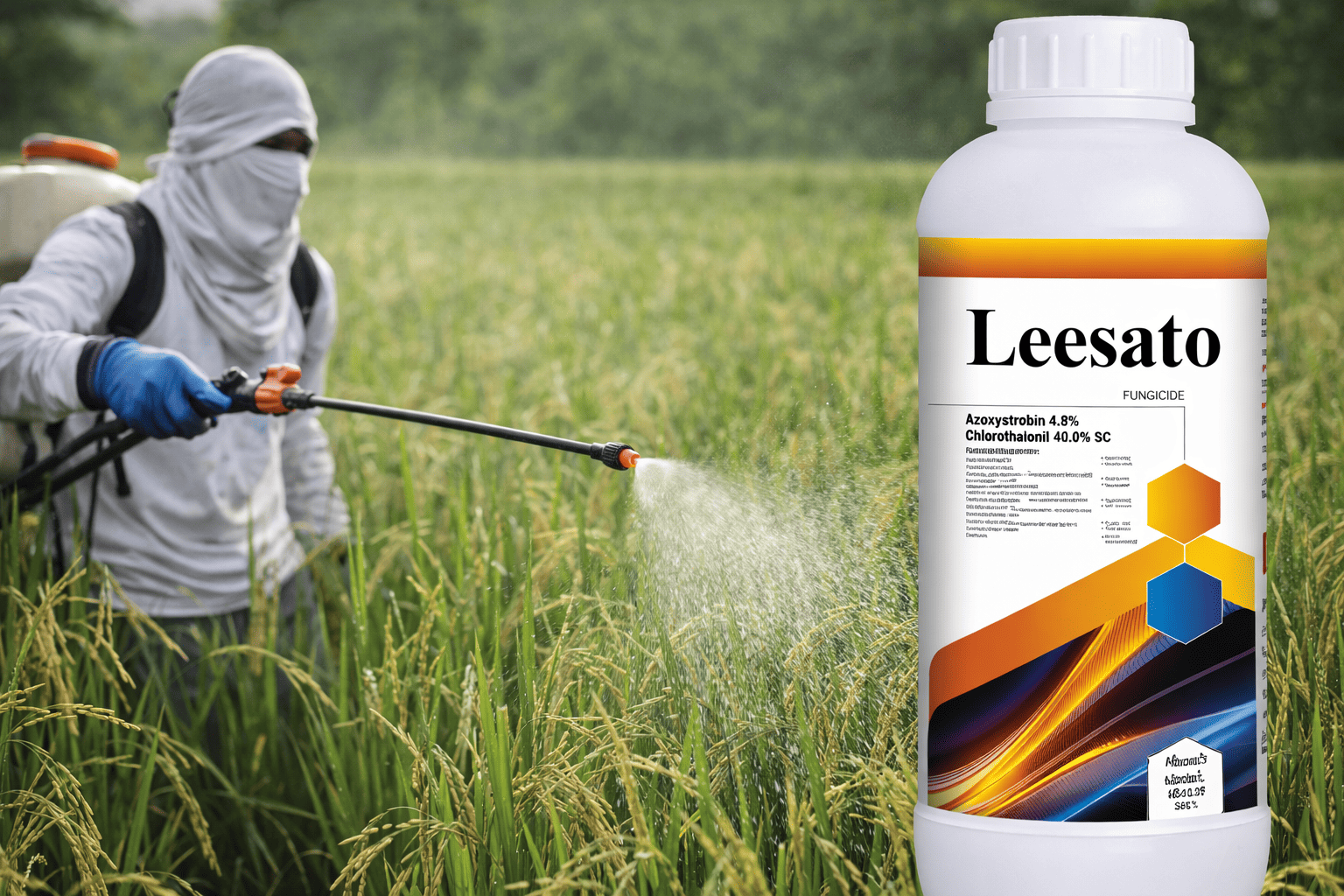
LEESATO

(Azoxystrobin 4.8% + Chlorothalonil 40% SC)

LEESATO is a broad-spectrum combination fungicide formulated with Azoxystrobin 4.8% and Chlorothalonil 40% SC, designed to deliver both preventive and protective disease control across multiple crop stages. The formulation integrates systemic and contact modes of action, allowing internal translocation alongside durable surface protection.

Azoxystrobin disrupts fungal energy production, while Chlorothalonil forms a persistent protective barrier that inhibits spore germination. 

LEESATO is particularly effective in crops facing recurring foliar diseases, dense canopy conditions, and prolonged humidity, supporting healthy foliage and maintaining crop yield and quality.

Technical Data

Active Ingredients
Azoxystrobin 4.8% + Chlorothalonil 40%
Formulation Type
Suspension Concentrate (SC)
Chemical Groups
Strobilurin + Chloronitrile
Mode of Action
Respiration inhibition and multi-site contact action
Action Type
Systemic and contact fungicide
Disease Control Nature
Preventive and protective
Movement in Plant
Translaminar with surface persistence
Target Infection Site
Leaf surface and internal tissues
Application Method
Foliar spray
Resistance Management Role
Dual-mode resistance suppression
Compatibility Profile
Suitable for integrated disease programs

Target Pests

LEESATO controls foliar fungal pathogens including blights, leaf spots, and mildew organisms by inhibiting spore germination and respiration, providing internal translocation and external protection against repeated infection cycles under humid field conditions.

Effectively Controls

  • Early blight fungi
  • Late blight pathogens
  • Leaf spot diseases
  • Fungal leaf blights
  • Alternaria infections
  • Septoria leaf blotch
  • Anthracnose causing fungi
  • Cercospora leaf spot
  • Downy mildew complexes
  • High humidity fungi
  • Airborne fungal spores
  • Multi-cycle foliar pathogens

Application Areas

  • Vegetable Crops High humidity growing conditions
  • Potato and Tomato Fields Protection against foliar diseases
  • Groundnut Crops Foliar disease risk zones
  • Pulse Crops Vegetative growth stage protection
  • Plantation Crops Dense canopy disease pressure
  • Recurring Infection Areas Management of repeated leaf diseases

Benefits & Advantages

  • Dual-Mode Protection Systemic plus contact action
  • Resistance Management Multi-site and single-site synergy
  • Broad Disease Coverage Controls multiple fungal groups
  • Long-Lasting Shield Persistent leaf surface protection
  • Uniform Spray Performance Stable SC formulation
  • Reliable Yield Protection Reduces disease-related losses